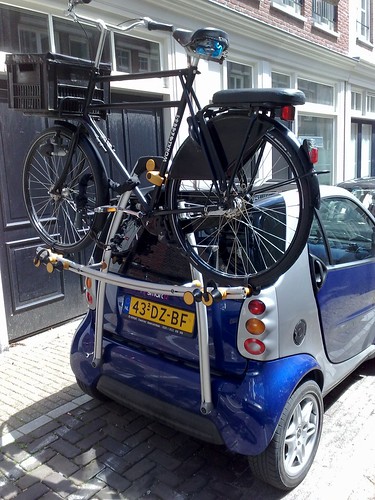
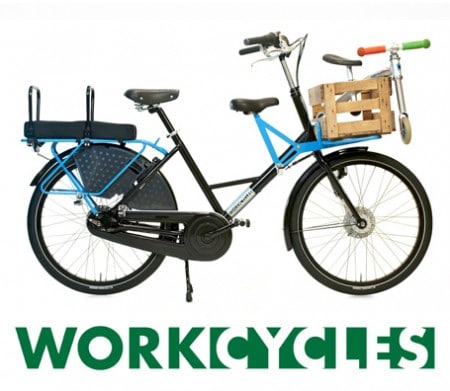
I’m surprised this little Smart car doesn’t tip over backwards when driving with this huge (70cm frame) WorkCycles Transport Double-Tube. But apparently a man of 200cm (6′ 6″) fits in a Smart.
Trivia: This is one of two galvanized Fr8′s. What seemed a cool idea turned out to be a nightmare to manufacture. The “twin” of this bike is on display at WorkCycles Lijnbaansgracht shop, and not for sale… unless somebody really wants to lay down some serious cash for it.
Just finished a special bike for Fromagerie Abraham Kef who’s shop is nearby in the Jordaan. Kef specializes in French cheeses they import (though they also have cheeses from elsewhere in Europe) and sells them both retail and wholesale to fine restaurants. Yes, despite their reputation for marginal food there’s good eating to be done in the Netherlands.
Because the soft cheeses must be kept consistently cold, it’s necessary to use highly efficient insulated transport boxes. That’s the blue ones, of which the bike can carry four at a time. Unfortunately the standard Bakfiets Cargobike chassis isn’t quite long enough to carry two of these next to each other. Thus we performed surgery: the frame was cut in two and another section of tubing was added in the middle. The frame was then reinforced with a rib, as found on the older Cargobike frames. Note that this is a Cargobike 2.0 with the 60mm tube plus the reinforcement rib.
In addition to the four insulated boxes we included a bog 80 x 60cm uninsulated crate for general transport. It’s not actually intended to ride with all five boxes stacked up, though we did prove it’s possible (and scary since you can barely see ahead).
Here’s a nice little video interview of Jan Rijkeboer, founder of Azor Bike where they make Bakfiets.nl, Onderwater and some WorkCycles bicycles. Jan proudly gives a tour of their factory in Hoogeveen… far from Amsterdam where their bikes are most popular. He describes how most of the parts come from the various factories in the Netherlands and elsewhere in Europe, and how people with various disabilities (or do I need to say challenges this year?) perform some of the functions in the assembly process. It’s in Dutch but you’ll still find it fun to watch even if you can’t understand this strange noise we call a language.
Here’s another classic Amsterdam bicycle child seat, this time true to the Dutch minimalist spirit. Two chunks of wood and a small piece of an old backpacker’s sleeping pad… almost certainly all found in the trash.
The bike’s also worth a look: A well-worn "opafiets" (grandpa bike) at least 50 years old with the front carrier from a baker’s bike.
Note that the handlebar is long gone. In its place the owner has attached a piece of steel tubing to brackets bolted to the front rack. This was quite solidly, if not attractively, performed and judging from the patina it’s been this way for decades.
There are lots of other nice Amsterdam touches:
frame is slightly bent at the head tube
the seat tube of the frame has been repaired with a weld
There’s a common misperception that the millions of bikes around Amsterdam are cheap “junkers”. Sure, there are plenty of low-quality bikes around the city but they don’t last long. Their parts wear out and break, or they rust badly and then the bicycle quickly becomes unrepairable and gets thrown away… or more often left to rot until the city declares it a “wreck” (“fietswrak”) and carts it away. This actually doesn’t take long at all – usually just a couple months.
Along with the unfortunate but unavoidable disposable, modern bikes are also an amazing number of remarkably old bikes. These bicycles, 30, 50 even 70 years old aren’t pampered and regarded as classics (though some could be considered so). No, they’re just somebody’s trusty transportation, often having been in continuous service for a couple generations.
That’s amazing when you think about it: 20 or 30 kilos of steel, rubber, leather and maybe some plastic “overbuilt” to such a high quality standard that it can reliably carry several or many times its weight for a service life unthinkable for most products. It’s an incredible material efficiency and all the more fantastic considering that these bikes live outdoors in a cold, wet climate. All of the bikes in my photos have rust, but it’s mostly the dark brown (sometimes beautiful) patina of quality steel; It forms an oxide layer after the original paint or chrome has been worn off and then doesn’t corrode further. This is partially because the steel has few internal impurities so it doesn’t rust from within. That’s the nasty kind of orange rust that’s impossible to stop and will quickly kill your bike.
This is also a lesson in the importance of simplicity. More complicated products simply have more things to go wrong, require more service and are more likely to someday be declared irreparable. Note in these photos how few of the bikes have gears or hand brakes. Vestigial frame mounts for rod brakes are common though I don’t see any in these photos. Nor is there much “design” to be found here. Many are lovely bikes but there’s no pretentiousness or design just for design’s sake. This also plays are role in durability: things that go out of fashion cease to be maintained.
The accompanying photos are just of bikes I happened across over the last two weeks, mostly on Thursdays (that’s papa day) while walking around the city with my five month old son Pascal. The newest bikes in the photos were made in the 1960′s and the oldest probably date back to the 1930′s. Most Dutch bikes stayed approximately the same through this period and the differences are only of concern to the the enthusiast and mechanic. Unfortunately very few of the bikes made after this period and virtually none of the bikes from the 1980′s to the present will last nearly as long as these.
It’s specifically this timelessness and durability that WorkCycles strives to achieve. It’s an uphill battle though, given the unavailability of certain parts (a good coaster brake hub…), customers expecting features such as multiple gears and hand brakes and a modern world economy of cheap products made with inexpensive materials and overseas labor. We’re working on it and continually making improvements.
Bas of www.transportfiets.net, (that’s trans-port-feets-poont-net for english speakers) turned me onto this super little video. It’s genuine film footage from a 1933 race in Bussum (near Amsterdam) on baker’s and butcher’s bikes. Back in those days most transport bikes had fixed wheels (“fixies” you young folk) and like all those modern-day urban hipsters on track bikes, these bikes had no brakes either. There’s a difference though: A transportfiets weighs an easy 50kg, and that’s before it was loaded down with 50kg of meat. The wheels alone weigh a good 10kg each. Can you say mo-men-tum?
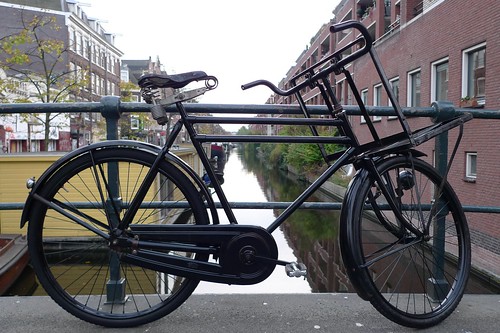
I have a handful of old “transportfietsen” in various states of disrepair and disassembly. They’re glorious machines; Very simple but so solidly made that they put all other bicycles to shame. Riding them is a great sensation. It takes a while to get up to speed but once all that mass is rolling there’s no stopping it.
These bikes were employed by practically every baker, butcher, milkman and other business in the Netherlands from perhaps the 1920′s until perhaps the 1960′s, when cars and delivery vans became affordable for small businesses. Keep in mind that the Netherlands was quite a poor country through modern history until the 1960′s. The bikes were ridden by delivery kids, much like pizzas are now delivered by annoying kids on mopeds with boxes on the back.
Note also that the Dutch Transportfiets predates the similar format but rather esoteric and much lighter duty French “porteur” or “veloporteur” by decades. Transportfietsen were also made in quite large quantities which partially accounts for the remarkably large number still on the streets, considering that the last of them went out of production in the 1970′s. Of course the fact that they were quality built like tanks also helps.
Transportfietsen were made by hundreds of firms, small and large and most of them look essentially the same: double top tube, huge front carrier fixed to the handlebar and (large) front axle, generally no rear carrier or parking stand. Pre-WW2 examples all had 28 x 1 3/4 wheels and usually fixed wheels. Later both 28″ and 26″ wheels were used and most were made with a single-speed Fichtel & Sachs Torpedo coaster brake hub. Parts such as chains and sprockets, forks handlebars, cranks, pedals etc were all bigger and stronger than on normal bicycles. I have never seen an old transportfiets originally equipped with gears or a front brake.
Have a look around transportfiets.net for tons of examples, including a number of bikes in restoration and also lots of old archive photos and catalogues. Bikes like this will never come back so it’s great that some enthusiasts are keeping them alive as examples of the values of another era.
Rick Wilson of Café Vélo in Portland, Oregon sent me this pic of his snowy WorkCycles Fr8. Its one of three Fr8′s in the USA, and was actually the very first Cross-frame made. The other two Fr8′s are at Clever Cycles (possibly available to purchase).
“In accordance with proper snow driving guidelines i added some ballast to the frontal load area of the Fr8 to ensure the front wheel had plenty of traction.
The Fr8 handles wonderfully in the snow with the Fat Franks and the bakfiets tracks well, but U turns are a bit tricky on slick snow covered pavement as would be expected. Would not want to be under the FR8 if it goes down, however ”
Rick seems to be quite a fan of our bikes considering that his family has four of them, or rather his family and business have four of them.
So, anyhow, a lot of people are asking why the Fr8 isn’t to be found on the WorkCycles site yet and that’s a perfectly reasonable question. There are a few reasons:
We’ve been selling them through our shops and a couple dealers faster than we can increase production so there’s been little reason to advertise what we can’t make more of.
A few customers have been promoting their own Fr8′s and getting the word out anyway.
We just haven’t had time to make the pages and related site changes.
But we’ve now got the design details sorted out and we’re ramping up production to vastly improve availability of Fr8′s in Spring 2009. In fact we’re even building a special, little factory to build the Fr8 and its future brothers and sisters. I’ll let you speculate just what those will be.
Fr8 pages on the WorkCycles site are finally in the works, and as you’ll note on our dealer page our network is expanding.
At the request of numerous readers I’ve begun compiling a sort of FAQ list for Bakfiets.nl Cargobike riders. I’ll add to it and flesh it out with photos as time allows. Your suggestions, especially with photos, are appreciated.
The much anticipated WorkCycles/Bakfiets Cargobike Extra Long is finally here! Ironically when Maarten van Andel introduced the original Bakfiets.nl Cargobike dealers and customers told him it was too long, too strange, too un-Dutch. To pacify them he designed the Bakfiets.nl Cargobike Short, even though he felt that the original (Cargobike Long) was the ideal length. Now its come full circle and the Dutch began complaining (they complain a lot actually) that the Cargobike wasn’t long enough to fit their kids, their kids’ friends, groceries, babies in Maxi Cosi’s, Bugoboo strollers, dogs and picnic baskets… at the same time.
We figured it’d be best to quit messing around and just go straight for Super-Size this time. Even the Dutch are learning from America! The new WorkCycles/Bakfiets Cargobike Extra Long offers room for 12 kids in the box and one more in a child seat on the rear carrier if needed. Alternatively you can carry 8 babies in Maxi-Cosi car carriers. Even with all those little ones in the box there’s still plenty of room for groceries, lumber, plumbing supplies or other gear.
The new size also solves the rising theft problem as well; At 6 meters long it simply doesn’t fit into any vehicles that can come into the crowded Dutch cities.