Archive for the ‘Child and family transport’ Category

Another fine, home-brew child seat

Wednesday, February 18th, 2009

home-brew-child-seat-amsterdam 1

home-brew-child-seat-amsterdam 2

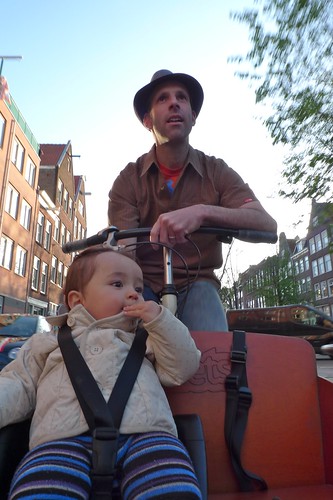
Here’s another classic Amsterdam bicycle child seat, this time true to the Dutch minimalist spirit. Two chunks of wood and a small piece of an old backpacker’s sleeping pad… almost certainly all found in the trash.

The bike’s also worth a look: A well-worn "opafiets" (grandpa bike) at least 50 years old with the front carrier from a baker’s bike.

Note that the handlebar is long gone. In its place the owner has attached a piece of steel tubing to brackets bolted to the front rack. This was quite solidly, if not attractively, performed and judging from the patina it’s been this way for decades.

There are lots of other nice Amsterdam touches:

  • frame is slightly bent at the head tube
  • the seat tube of the frame has been repaired with a weld
  • there’s a ring lock but not fixed to the frame
  • antique “Koets” taillamp is hanging limply
  • the poster behind the bike
  • A few weeks ago I showed off another creative Amsterdam child seat.

    New Bakfiets parking area at Amsterdam Centraal

    Sunday, February 15th, 2009

    As part of the constant struggle to provide parking for the ever growing number of bicycles ridden to Amsterdam Centraal Station every day the city of Amsterdam is building a special parking area for bakfietsen. This will be directly across from the famous and much photographed fietsflat. There will only be 40 parking spaces but that’s better than the zero available now. Presently those who need to park a bakfiets at the station can either park it a couple blocks away or in the two indoor “fietsenstalling” run by MacBike.

    fietsflat amsterdam station bike parking facility bicycle parking garage in amsterdam Amsterdam bicycle parking garage
    Bicycle parking on ferry in amsterdam old ferry used as bike parking at amsterdam station fietspont, bicycle parking behind amsterdam centraal station

    Why ride a bakfiets to the station when it’s so much more difficult to park than a normal bike? Well, a parent might drop the kids off at school and continue on to the station during their morning commute. Or a family might go to the station with the kids in order to take the train to visit grandma, or for a weekend in Paris or…

    The problem is that providing parking for all the bicycles is a hopeless battle. Each day 250,000 travelers pass though Amsterdam Centraal, a considerable number of whom arrive by bicycle. This is not surprising considering that it’s the most practical and cheapest way to reach the station for most of Amsterdam’s residents. But Amsterdam Central stands on a small artificial island so space is very limited. Current bicycle parking includes:

  • Fietsflat: Designed for 2500 bikes but generally crammed with 4000.
  • Fietspont: a decommissioned ferry with a couple hundred parking spots
  • Indoor parking: Mac Bike operates two guarded bike parking garages, each with capacity of about 500 bikes.
  • Fietsbarges: There are a couple floating bike parking lots.
  • Random parking: Bike parking is tolerated in some locations around the island.
  • fietsen

    Photo by Flickr user Ron Layters

    In total I’d estimate there are about 6000 bike parking spots on the island. Locals know that it can be nearly impossible to find a place for your bike if you arrive at the station after rush hour so they take public transport instead. Cycling is also gaining in popularity in Amsterdam, recently accounting for more than 50% of trips made. Thus the need for bike storage always remains greater than the supply, despite constant additions. The city plans to reach 10,000 bike parking spots within a few years but it’s likely it will continue to remain at capacity.

    Nonetheless the city recognizes that cycling is still the most efficient and least resource intensive way to more people around the city. Passenger capacity of the trams, buses and metro are also being expanded but this is far more difficult and expensive. Getting to Amsterdam Centraal by car has already been rather hopeless for a long time.

    Family of four on a WorkCycles Fr8

    Thursday, January 22nd, 2009

    WorkCycles FR8 family of four

    A very sweet customer sent this pic along with permission to use it.

    In case you’re wondering… Yes, she does ride this bike with all three kids aboard, though I’m not sure exactly which positions the kids sit in:

  • The Fr8 rear carrier has a place for a second seat which they’re not using.
  • Behind the handlebars is a special little saddle with footrests. The child sitting there is younger than usual, but if she knows she needs to hold tightly and can’t fall asleep it should be OK.
  • The front carrier isn’t officially a child seat, but we’ve seen that many people use them that way, at least for fun. The oldest daughter rides her own bike most of the time
  • Test: Carrying a Newborn on a Bike

    Tuesday, January 20th, 2009

    A little background here: Many moms carry their babies around by bicycle here in the Netherlands. It’s pretty much a necessity when families live in densely packed cities where driving an automobile is neither practical, pleasant or affordable. At WorkCycles we’ve always recommended that this be done by putting the child in a Maxi-Cosi (by far the most popular make of car seat for infants), secured in the box of a bakfiets. We mostly do this in the Bakfiets.nl Cargobike but a number of others are good as well. We have a lot of experience with this system and haven’t seen any problems. Customers have even told us stories of accidents that their babies SLEPT through. In short a baby appears to be fairly safe in a protective car seat, in a sturdy wooden box, only several centimeters from the ground.

    But not everybody wants to ride a Bakfiets and we customers regularly ask us to mount the Maxi Cosi on the front or rear carrier of a standard format bike… which we’ve steadfastly refused. Colleagues of ours do this regularly and quite a few customers have left one of our shops and gone straight to “brand X” where they’ve bought a bike equipped this way. We haven’t really helped the customer in such a case and we’ve lost a sale as well. I wanted to research the matter further.

    bike-steco-baby-mee-maxi-cosi

    Photo: Example of a bike equipped to carry a baby in a Maxi Cosi over the front wheel, NOT from WorkCycles.

    Setting the Maxi-Cosi on a front carrier seemed like a BAD idea but perhaps acceptable with our new, super heavy duty and stable Fr8 bike. So I built a test rig and experimented with Pascal, then 2 mo old. Kyoko and I each rode the bike for an afternoon on a variety of (quiet) roads and smooth paths in Amsterdam.

    One of our complaints with carrying babies on standard type bikes is that the parking stands are inadequate to hold the “load” stably. This is particularly true since the baby is set high over the front wheel while most bikes have their parking stand beneath the crank axle. That’s just not stable. The Fr8 is built differently: The rack is mounted with just enough clearance over the front tire and a very wide and stiff stand is integrated into the “Massive Rack”. This rack and stand are actually rated for over 150kg of cargo so a few kg of baby, Maxi-Cosi and the overbuilt system were not going to tax it. Test one passed with flying colors.

    The system holding the Maxi-Cosi looks cheesy but it’s actually extremely solid and secure. I wouldn’t have put my 2 month old son in there otherwise! I bolted a board to the carrier and strong tie-down straps secure the Maxi-Cosi. In the bag below the Maxi Cosi are a stack of blankets and cushions for shock damping. It’s not visible in the photos but Pascal IS strapped into the Maxi Cosi under the blankets.

    Riding the bike with baby aboard was obviously no problem, but wasn’t nearly as confidence inspiring as having the baby low in the wooden box of the bakfiets. There remained something unnerving about having the baby so high and in your sight line.

    While riding we discovered the real problem with such a system: damping of large amplitude vibrations from the road surface… shaking the baby in other words. On perfectly smooth surfaces it was fine, but even the smallest irregularities in the road caused Pacal’s head to shake up and down. Even with the giant 54mm tires of the Fr8 so soft that they almost rolled on the rims, a small pothole or root pushing through the road caused unacceptable shaking.

    Project over thus:
    The shocks transmitted through the bike in such a format are simply unacceptable for a small baby, and short of an elaborate suspension system there is no way to counter it. An adequate suspension would require much more vertical distance between the baby carrier and front wheel and this setup was already as high as I would consider acceptable. Thus any further work in this direction would require a bike with a much smaller front wheel.

    We maintain our position that carrying a baby on the front of a “normal” format bike is not acceptable and will not offer this until we’ve found a better approach.

    Chinese Family Trike

    Monday, January 19th, 2009


    Chinese Family Trike, originally uploaded by henry in a’dam.

    WorkCycles mechanic Tom Resink has been traveling through China and Tibet and snapped this photo of a family on their cargo trike in Chengdu.

    Creative “baby seat” on a Kronan

    Tuesday, January 13th, 2009


    swing seat on kronan bike 1, originally uploaded by henry in a’dam.

    This is just a bright green bike child seat, right? Look again. It’s a cheap and broken swing tied to a Kronan bike with the rope normally used to hang it from a a tree. I don’t think this baby seat is approved by any official bodies.

    It is a good example of the relaxed attitudes about child transport and cycling in general in the Netherlands, particularly Amsterdam. Cycling is simply not regarded as a dangerous activity and for good reason: the statistics demonstrate that it isn’t.

    Nonetheless, I’ll be taking somewhat more care than this with my own kids, thank you.

    swing seat on kronan bike 3
    Note the use of an old mouse pad as a cushion.

    swing seat on kronan bike 2
    Here’s a better view of the old swing rope used to “secure” the seat to the Kronan’s (flimsy, sheet metal) rear carrier.

    Kyoko’s Bakfiets Cargobike

    Tuesday, November 4th, 2008

    Keeping with the spirit of “practice what you preach” its to be expected that Kyoko and I would be transporting our son Pascal around in a Bakfiets Cargobike. We actually considered bringing him home from the hospital in a bakfiets but figured we’d just be tired and Kyoko would have no interest in sitting on or in a bike at that point. In fact we we’re totally wasted tired and definitely in no mood for cycling, even those two flat kilometers. It was one of the few times we’ve ever been happy to see a taxi in Amsterdam. Come to think of it it was also the only time Pascal has been in a car in his 11 week life.

    After four weeks Kyoko was cycling again and Pascal seemed ready join his mom. I hadn’t even begun building our own bakfiets so I “borrowed” one of the WorkCycles rental/loaner bakfietsen for a few days and bolted in one of our Maxi-Cosi carriers. Its probably an exaggeration to say that Pascal “enjoyed” the ride, but he did sleep soundly the entire time; It certainly wasn’t bothersome for him.

    We’ve had pretty terrible weather this fall and that’s good for keeping customers out of the shops. Thus I finally had time to build Kyoko’s own bakfiets. Perhaps I went a little over the top with the custom wheels with orange hubs (Sram i9 9-speed and Shimano dynamo hub with IM70 rollerbrake), orange painted fenders, lighting wiring run completely through the frame and rear carrier and a hundred other little, obsessive details. The Sram hub is in there just to get some experience with it. We generally avoid Sram gear hubs but Shimano’s are sometimes unavailable so its good to know the alternatives.

    But wait… didn’t I recently write that I don’t obsess about my own utility bikes? Yes I did, but this is my wife’s bike, not mine.

    Just to note, you might wonder whether its significant that I chose an “old-model” Bakfiets Cargobike instead of the new Cargobike 2.0. The answer is simple: No, Kyoko just wanted an ivory white bike with colored parts and we had a Cargobike 1 and parts that fit the bill. In any case the differences between the two models aren’t enough to really care one way or the other.

    Now at 11 weeks old Pascal sometimes stays awake while cycling, gazing back at mom or out (mostly upward) at the world. He seems very content tucked in his Maxi-Cosi, inside the canopy. The Maxi-Cosi snaps into his pram (a compact Bugaboo Bee, yes we’re very happy with it)… which easily fits into the rear of the Cargobike box. So Kyoko or I can bring the baby and a complete pram along in case the destination requires a fair amount of walking. Very handy!

    The bike is parked in front of our house, where it will mostly live. We figure the very open location on the canal and next to a bridge makes it very visible from two streets and dozens of apartments. A thief would be very bold to fire up a disk grinder to cut through those hardened 10mm chains, though I doubt it’ll stop the local urchins from tagging the box.

    WorkCycles and Bakfiets.nl win Kassa bakfiets comparison test

    Sunday, October 26th, 2008

    Yesterday “Kassa” (cash register) the popular, prime-time, Dutch consumer program broadcast their test of family bakfietsen. Like some other consumer-rights organizations Kassa reports are widely regarded as quite reliable and honestly conducted. Despite my usual cynicism I felt the testing procedure they showed was quite rigorous utilizing two professional experts and a panel of experience experts, namely parents with children. A retailer specializing in child transport bikes and trikes provided lessons to get the parent testers proficient on the bikes as quickly as possible.

    It was not a long-term test though, and it would be expected that some conclusions would change with further use of the bicycles. Our experience has been that the two wheelers gradually become more favored as parents get comfortable with them, while riding a trike tends to get “old” after the novelty wears off. This is apparently a particularly Dutch sentiment as our colleagues in Denmark, England and Germany swear by the trikes. Different strokes for different folks.

    The testing appeared to have been conducted over a few days and many interesting moments and comments were captured on video. Amongst the most notable:

  • A woman overturning a Christiania trike, complete with two kids in the box
  • One expert noting that some bikes ride well empty but poorly with a loaded box, others ride well loaded but poorly empty and a couple ride well regardless of the load.
  • Moms trying to push loaded bakfietsen up a tall curb
  • (more…)

    New page: Bakfiets Cargobike Tips & Tricks

    Monday, August 18th, 2008

    At the request of numerous readers I’ve begun compiling a sort of FAQ list for Bakfiets.nl Cargobike riders. I’ll add to it and flesh it out with photos as time allows. Your suggestions, especially with photos, are appreciated.

    School Bus Tricycle in India

    Wednesday, August 6th, 2008

    india-school-bus-tricycle.jpg

    Image found on Treehugger

    I find this Indian rickshaw converted to a school bus to be particularly bizarre. There’s nothing at all strange or bad about carrying kids to and from school in a trike. In fact WorkCycles sells trikes specifically made for this purpose and they’re becoming quite popular in various cities around the Netherlands. The kids love it. See the examples below:

    de redding kdv bakfiets met kinderen in de bak zes kinderen in de bak van een deredding kdv bakfiets Kinderen klimmen uit de bak van een deredding KDV bakfiets

    No, what’s bizarre about the Indian bicycle school bus is how is almost seems to have been designed to be unpleasant for the kids yet not out of economic necessity. A couple of the kids inside are smiling but I suspect its just for the camera. The others don’t seem too happy about the situation and who can blame them? I count at least nine kids in the box. There’s no way to make a bike to carry nine kids in spacious comfort but I’m sure it could be better than this.

    I just don’t get it. It looks as if the child carrier box has been built especially to fit this rickshaw chassis, as opposed to having been adapted, second-hand from some other vehicle. But maybe that’s not the case – perhaps the box was originally intended to carry livestock such as sheep, a task it seems better suited for.

    Otherwise why make such a cramped and enclosed kid carrier in a place that gets so hot? The roof could easily be higher and still carry the backpacks and protect the kids from sun/rain. Why are the windows so tiny… and further covered by a metal cross bar? Would the kids otherwise jump out and run away? I would. Likewise, with no significant additional cost the box could be extended to the side over each wheel to create more space inside.

    Call me arrogant but I don’t believe this situation has anything to do with economics. It just seems like lousy design. Can anybody shed more light on these bikes and/or schools and/or children in New Delhi? Are there reasons beyond my narrow-minded, egocentric comprehension that have dictated this design? Is “public school” actually just a euphemism for “jail for juvenile delinquents” in New Delhi? Please help because my head is spinning.