Archive for the ‘Bicycle parking and storage’ Category

Copenhagen-Amsterdam War in the VogelVrije Fietser

Wednesday, January 13th, 2010


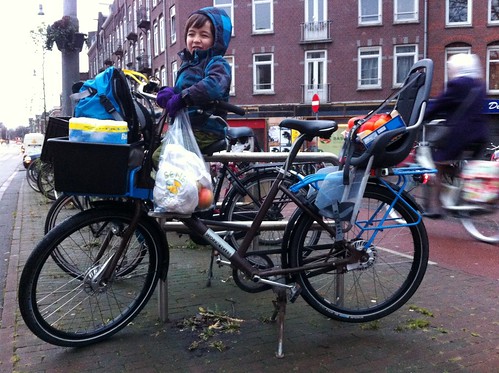
Some Danish guy on a WorkCycles rental bike in Amsterdam, originally uploaded by Amsterdamize.

I usually flip through the “VogelVrije Fietser” (literal translation: “Birdfree Cyclist”) in about 30 seconds and then pass it to my toddler son for shredding but this issue (January 2010) had a few bits worth sharing… before Pascal gets his way with it. The first interesting piece is the latest salvo in the imaginary Copenhagen-Amsterdam war of cycling supremacy. The Copenhagen ambitions to achieve or already have achieved the coveted, self appointed title of World Cycling Capitol are already all over the Internet and the BirdFree Cyclist even made the trek up there to the great white north to see what all the fuss was about. In a nutshell they made the great revelation in the previous issue that the crafty Copenhageners were just as busy improving cycling facilities in their city as in most Dutch cities, and that they’re being more vocal about promoting this fact. Whoopee, the Danes also see value in a city where many people cycle!

Now after a flood of backlash from indignant and competitive Dutch cyclists the BirdFree Cyclist interviews a number of Dutch lawmakers about the Great Copenhagen Question. Amongst other things they ask about the Copenhagen ambition to have 50% of all commuters on bikes by 2015. Being an Amsterdammer (OK a transplanted New Amsterdammer…) I’ll focus on and translate some comments from Hans Gerson, Amsterdam city Alderman from PvdA (Labor Party):

Hans Gerson (who’s sitting on a bike while carrying a folding chair in one hand in he accompanying photo):

“I know Copenhagen a bit. I think there’s much less cycling there than with us. But fine, let’s assume they want to compete with us. Fifty percent is completely no task. In the center of Amsterdam more than 50% of all trips are already by bike. I would want to set the bar higher. For the entire city already more than 38% of all trips are done with the bike. I find fifty percent a nice challenge for 2015.”

Gerson’s emphasis here seemed to have beeen missed by the interviewer: The Copenhagen goal is to have 50% of commuters cycling. This is certainly a worthy goal but commuters represent a relatively narrow segment of the population: working adults in their prime years. Thus we’re comparing apples and oranges. Which translates to more cyclists: 50% of commuters or 38% of all trips within the city by all people. I’d guess the latter but…

a. I’d have to dig through the CBS statistics to prove it.
b. Who cares anyway? The Dutch and the Danes are hard at work improving what are already the best cycling facilities in the world by an enormous margin.

But just because it’s fun to poke our Copenhagen friends I’ll add some more of Gerson’ comments:

BirdFree Cyclist: You totally don’t see Copenhagen as the winner?

Gerson:

I was there recently. It’s a really pretty city OK, but the number of cyclists there could be counted on one hand. Thus I can’t imagine that it even comes in the neighborhood of being a our competitor. And wherever I go in the world we’re always prized for our bike policy. But we’re not resting on our laurels. Lots must still be done.

Ooh, ouch Copenhagen! That hurt, and then to think that Amsterdam is only one of dozens of Dutch cities that take cycling so seriously. Darn, now I’m getting all into this competition thing too. Sorry folks.

amsterdam sunday 4

But for those not so into this international intrigue there was also something fun for the tech weenies. The BirdFree Cyclist used an SRM power output meter to test the effects of various maintenance and component choices on the effort required to cycle. I’m assuming the test wasn’t executed to nano-precision standards but a few of the results are nonetheless interesting:

  • Shimano hub dynamo – 1 watt
  • rusty chain instead of clean, new chain = 1 watt
  • too tight chain = 12 watts
  • Hebie Chainglider chain cover = 4 watts (regular chain-case = 0 watts)
  • Shimano Nexus 7 speed hub in 4th gear = 12 watts
  • heavy city bike tire vs. racing type tire = 15 watts
  • tire pressure 2 bar instead of 4 bar = 25 watts
  • What can we learn from this?

    Well, fixing flats in cold rain sucks so racing tires aren’t practical for urban use but pumping your regular tires up is worth the effort. Also the considerable difference between the tires suggests that smooth running tires such as Schwalbe Marathons are worth the small additional cost.

    Ride a bike with a full chain case because not only does it not cause drag, your chain stays clean, lubricated and happy inside. But don’t pull that chain too tight. Still, I suspect that the chain test would have shown a much greater difference had he compared the new chain to a real Amsterdam chain.

    Our feeling that Shimano’s Nexus 7 speed hubs are factory filled with crunchy peanut butter seems to have more scientific basis now. Early Shimano 8 speeds suffer from this problem in the 4th gear too but that’s a number of years ago now.

    old gazelle bike crank in amsterdam 32

    De Fietshangar (bike hangar)

    Thursday, December 17th, 2009

    fietshangar 2

    Several years ago while I was doing a project with design students at Technical University Eindhoven I met Jelle Zijlstra of Zijlstra Industrial Design. He’d designed the “Fietshangar“, a protective bicycle parking unit that replaces half a car parking spot. The concept is brilliant and philosophically I just love the idea that a single car parking space will be replaced by ten bike parking places. There are already a few hundred Fietshangars in use in various Dutch and Belgian cities and several hundred more are scheduled to be installed.

    fietshangar 3

    It is estimated that some 900,000 bikes are stolen each year in the Netherlands, about half of which were parked outside at home (statistics from CBS). Our experience selling city bikes at WorkCycles suggests that the perceived risk that a bike will be stolen (or vandalized or damaged) has a considerable influence on both cycling behavior and the sales of bicycles; There are a few people who’ve given up cycling after having their umpteenth bike stolen but more often people simply choose to ride crappy bikes to avoid theft and minimize the loss if their bike gets stolen anyway. The theft problem does vary widely by location; As expected it’s not a big problem in more upscale urban neighborhoods and certainly not in the villages and smaller cities. In the urban neighborhoods with mostly social housing and sketchier areas of the city center bike theft and destruction is really a plague. Just to note: The question of why fewer immigrants ride bikes comes up frequently but I’ve never seen anybody take into consideration that the areas with the highest concentrations of immigrant populations are lousy places to leave a bike outdoors. Few people have an indoor place to store a bike thus that tram gets more attractive each time you walk outside and find either your bike with a wheel flattened to the ground, your bike with the saddle slashed open, or no bike at all.

    Thus the Fietshangar offers a solution for those (potential) cyclists who live where their bike otherwise wouldn’t be safe. There are two versions: A standard model that offers a basic level of protection, and the heavier duty, more secure Fietshangar+. The latter version is normally installed by a city.

    I’m not sure whether Fietshangars have been installed outside the Benelux but if you’re interested you can contact the manufacturer: Heimerink Wagemakers. Their site’s in Dutch but the contact info is at the bottom of each page.

    fietshangar 1

    Who steals an old bakfiets wheel?

    Tuesday, August 18th, 2009

    Our web developer Doede sent me a despairing note the other day telling me that the rear wheel of his new, old bakfiets got ripped off. The poor beast looks so sad, like a horse with a broken leg.

    In case you’re confused thinking that a bakfiets is a modern, two-wheeler that mom carries her kids in, you’re half correct. That’s a Bakfiets Cargobike, with Bakfiets being the very generic trade name for Maarten van Andel’s brilliant bike. But to Dutch folks “bakfiets” still generally means a giant, heavy duty three-wheeler with a wooden box on the front, a brake lever between your legs and a fixed gear to keep those legs busy. Just to be sure: “bakfiets” is singular and “bakfietsen” is plural. Please remember that as it’s quite painful to read “bakfiet”. Check here for a more detailed description of the etymology of bakfietsen, bakkersfietsen, bakkers, bakken, gebak…

    Anyhow the theft raised the question of who would bother stealing an old bakfiets wheel. They’re nearly impossible to find but then again such a wheel has no significant market value. Thus Doede’s wheel was probably stolen by another bakfiets owner whose hub, drum brake or rim finally died after 40 or 50 years of faithful service. And who rides old bakfietsen like these? Well, Doede reasoned, not the sorts of people you’d expect to be stealing their fellow bakfiets riders wheels: hippies, squatters, socialists and others well to the “left” of the socio-political spectrum. Just goes to show you that you can’t judge a book by its cover… or that such demographic stereotypes don’t actually work for crap.

    [UPDATE 26-08-09: On Sunday while cycling out of the city with Kyoko and Pascal for a day trip we came across a scene I'd never witnessed before: A building getting broken into and squatted. A raucous mob of perhaps 50 men and women with creative hair and almost entirely black clothing was smashing their way through the door of a pretty, 17th century building in the Weteringschans. Upon breaking the door open the crowd cheered and stormed inside with the contents of a delivery van and no less than two big, old bakfietsen. I also recognized a couple of Amsterdam bakfiets/transportfiets "colleagues" of the old skool variety. Just goes to show you that some stereotypes have a basis in reality.

    I pulled my camera out to get a couple pics of the bakfietsen playing a key role in the squatter's life, but I was immediately apprehended by somebody apparently appointed the "no fucking pictures" man of the event.]

    In case you’re wondering what sort of rear wheel would be supporting the rear frame of that bakfiets had some scumbag not stolen it, here’s a quick description:

  • Transporter tire 26 x 2.25″ or 26 2.5″, roughly equivalent to an old motorcycle tire
  • Thick-walled steel rim about 50mm wide
  • 36 or 40 spokes in 8 or 10 gauge (3.0 to 3.6mm thick)
  • Steel hub with large, hand operated drum brake
  • 1/2 x 3/16″ cog bolted to the hub (fixed gear)
  • It would look like this one on a brand new WorkCycles Bakfiets, meaning thus that such wheels are actually still available… just not at a price many old-fashioned bakfiets riders are prepared to pay for:
    bakfiets-achterwiel

    And here’s a picture of a whole, brand-new classic bakfiets, just because I’m so thrilled that such gorgeous, durable, early 20th century vehicles can still be in production. In the background is the Nijland factory where these bikes are made for WorkCycles:
    bakfiets-nijland

    Eddy’s rogue loopfiets strikes again!

    Wednesday, July 29th, 2009

    fietsen-worden-verwijderd

    “Fietsen worden verwijderd” = “Bicycles will be removed” and is a common sign in Amsterdam since bicycles cover every usable wall, sign pole, lamp post, fence, gate, bridge railing, fence, window (and bike rack). Putting a Fietsen worden verwijderd sign on your window or door is no guarantee that the spot will remain bike free but it’ll at least keep the most conscientious people away.

    Ahh, but why is it also written in Chinese characters? I’ll just leave that as a mystery for the locals to answer.

    Addition to the WorkCycles sticker

    Tuesday, July 28th, 2009


    IMG_1916, originally uploaded by henry in a’dam.

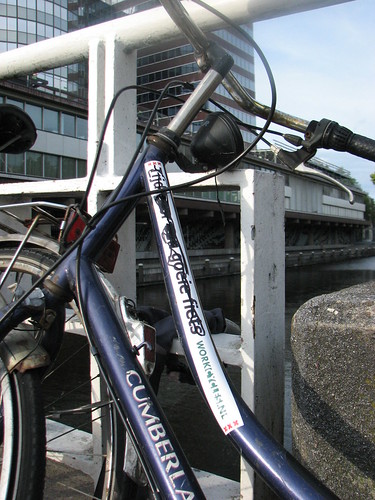
    OK, so perhaps somebody disagrees with the sticker: “Tijd voor een goeie fiets” (time for a good bike)… but at least they had the decency to leave the workcycles logo intact.

    ROT OP MET DEZE &*%$#@! FIETS!

    Saturday, May 16th, 2009
    fuck off with this fucking bike

    unsolicited sticker found on doede's bakfiets

    Our website dude Doede van der Linden sent me this pic today. Somebody stuck this sticker on his Bakfiets Cargobike today.

    “Rot op met deze &*%$#@! fiets” roughly translates to “Fuck off with this fucking bike” .

    In other words somebody is displeased with Doede’s choice of bicycle. Below, the same in better detail.

    Fuck off with this fucking bike

    The sticker in all it's glory

    Here we can read the smaller text below.

    Dit is een asociale fiets hij is echt te groot en waarschijnlijk kan ook jij er niet normaal mee fietsen

    And in English: “This is an antisocial bike it is really too big and you probably also can’t cycle normally”

    Now let’s consider this more carefully.

  • The sticker shows a (very badly drawn) bakfiets with three kids, thus demonstrating that the sticker maker/sticker understands at least one function of such a bike.
  • He’s (and almost certainly a “he”) is writing in (bad) Dutch about a very Dutch topic. It seems reasonable to guess that he’s somewhat familiar with bikes and thus understands that one doesn’t carry three kids on any ordinary bike.
  • So I can only infer that he’s expressing his disapproval that a family should have three (or more) kids.
  • Now if anything is antisocial it’s telling people, unsolicited, by sticking things on their bikes, that they have too many kids, that they ride a bike that’s “too big”, and that they probably can’t ride a bike normally. So fuck off, you righteous asshole! Put stickers on your own bike and don’t tell people how they should live. Be happy that Doede rides a bakfiets (no wider than the handlebars of a normal bike in case it matters) instead of driving a Cadillac Escalade. And be happy that you live in Amsterdam, cycling capital of the world.

    Amsterdam S&M love bikes

    Monday, May 19th, 2008

    handcuffed-love-bikes.jpg

    Not visible in photo: the bikes were a men’s and ladies’ pair. From my neighborhood free newspaper “De Echo”.

    Bicycle Tree Parking

    Tuesday, May 13th, 2008

    bike-in-tree.jpg

    bicycle-tree-parking.jpg

    Coincidence? I don’t think so!

    bicycle tree parking” (second photo) via swissmiss where you’ll find lots of interesting design stuff, some of which is bike related… others just thought provoking or beautiful.

    Automated bike parking in Tokyo

    Friday, May 2nd, 2008

    Automated bicycle parking garage in tokyo

    A friend sent me a link to a new robotic bike parking system in Tokyo, reminding me of one of my favorite topics: where to put all the bikes when everybody cycles. The Tokyo system is very cool and executed on quite a large scale. It apparently has space for 9400 bikes. Just for reference a parking garage for 9400 cars would be enormous – a quick calculation suggests that it’d be at least 150,000 m2 in surface area or perhaps much more considering all the entrance and exit paths necessary to keep it flowing.

    The video of the parking garage in action here can be found on a gazillion sites already so here’s a French language blog with a thorough description with photos and videos of the Tokyo system at Kasai (train) Station. The photo above is from this site and the author is apparently busy with an English translation. There are also many nice pictures and descriptions of the 2008 Sakura, the cherry blossoms the Japanese are crazy about.Cleanliness and technical perfection aside I’m skeptical about whether such an elaborate, high-tech bike parking system is really necessary. For example, the humble fietsflat in Amsterdam holds about 4000 bikes on any given day and its nothing more than a three level metal structure with a lot of bike racks. Of course the fietsflat and its users are not so kind to your bicycle.

    Amsterdam bicycle parking garage

    There are also other automated bike parking systems. This Dutch system called “Fietsmolen” (Bicycle Mill) is simpler and seems to offer much higher density. A couple examples have been built in Holland. The fietsmolen is basically just a carousel with one or multiple concentric rings of bikes. Each ring rotates independently of the others and gets its own entrance. A two ring system holds 100 bikes and according to the creator rings can be placed inside and outside the basic module. That would offer space for about 200 bikes per unit, comparable to the 180 bikes per unit in the Tokyo Kasai system.

    fietsmolen bicycle parking carousel

    The Fietsmolen system can be placed underground or above ground, as needed. Of course multiple Fietsmolens could be installed together as has been done in the Tokyo Kasai system. When installed back to back the Fietsmolens pack together very densely.

    The Fietsmolen site is in Dutch and not especially handy either. Keep clicking and you’ll find photos and examples.

    Amsterdammers whining about Bakfietsen

    Thursday, January 10th, 2008

    lots of bakfiets cargobikes parked on an amsterdam sidewalk

    Just like we predicted a few years ago, bakfietsen, Cargobikes and transport bikes are now an unavoidable part of the Amsterdam street scene. They’re especially popular in some neighborhoods with many young families. But all changes bring complaints and this one is no exception; Childless residents are complaining that the sidewalks are covered with big bikes.

    My opinion: Its true, the bikes shouldn’t be crowding pedestrians on the sidewalks. They should be crowding cars off the streets! I vote for gradually converting automobile parking spots to bicycle parking spots. Problem solved.

    Of course such a plan is great for the livability of the city, but will obviously find many opponents since the city derives considerable revenues from the parking permits and meters. Parking a car in Amsterdam is very expensive, but I’d expect any plans to charge for on-street bicycle parking to go over like a lead balloon. Besides, bicycles aren’t even registered here (anymore) making it nearly impossible to manage anyway.

    Photo by Lukas Göbel from the Volkskrant (newspaper) 10.11.2007. In this photo you can spot the following:

  • Bakfiets.nl Cargobike Long and Short
  • Bakfiets.nl Biporteur (an early transport bike from Maarten van Andel)
  • Christiania trike
  • Sparta Pickup
  • Kronan (looks like it might even be in working condition!)
  • Lots of kids bikes
  • Lots of panniers (we leave them on the bike here)
  • Lots of front carriers
  • Plenty of child seats