Creating Cyclists: Start ‘em Young
TweetIn promoting cycling for transportation worldwide most of the discussion and action tends to focus on getting adults on bikes, particularly for that very American concept of “commuting” a considerable distance from home to work. Here in the Netherlands cycling for transportation just means generally getting around by bicycle. It’s mostly short distances since people tend to live much closer to work or school. Few would consider cycling greater distances unless it’s just for fun; Urbanites would instead take a train and country folk would most likely drive.
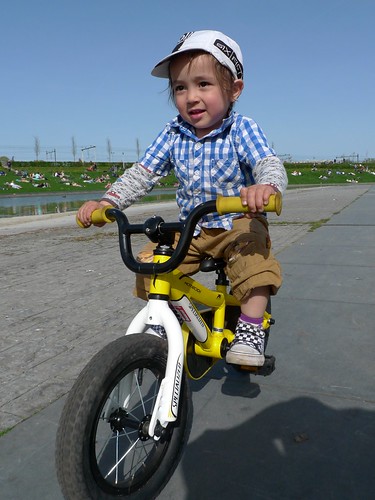
Here cyclists are mostly created from birth, both by example and by teaching kids to ride bikes at a very young age. Below is our story of our son P1 who now at the tender age of 2 1/2 is quite comfortable on a real pedal bike without “training wheels”. With a sample of one it’s certainly not scientifically proven but friends and customers have also had success with the same methods. So without further ado, here’s a timeline of P1′s development as a cyclist (so far). Please note that not all of the pictures show P1 at the age the activity actually begun:
1. One month: Riding as passenger in the bakfiets
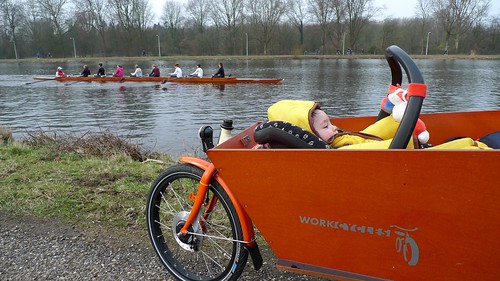
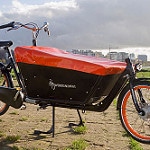
It’s debatable whether feeling the motions of cycling from a very early age contribute toward one’s inclination toward cycling, or their development of balance months later. But P1 visibly enjoyed riding in the bike, watching the sights and sky go by. As young as four or five months old we were taking him on longer cycling trips, for example along the Amstel river as in the photo above. The bike is our very popular Cargobike Long.
2. Eight months: Riding as passenger up front on normal bike
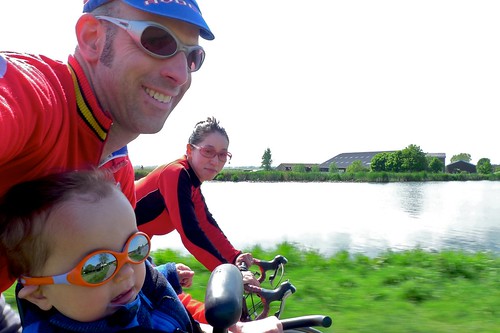
We normally state nine months as the time to begin carrying a child in the front seat. P1 was already highly mobile and had been sitting securely for quite some time at eight months so we started a little earlier. Again it’s debatable how much this relatively passive activity contributes to the later development of cycling skills but my educated guess is that riding in the front seat of a parent’s bike is so much like cycling that there must be some learning involved. Kids are like sponges for knowledge and skills and here they’re seeing and feeling the world from exactly the same perspective as the cyclist; the dynamics of cycling, the sights of the city, the interactions with other road users. They even learn how to use the bike’s controls; P1 began pulling on the brake levers, twisting the shifter and ringing the bell within a year or so. Sometimes it’s terribly cute but other times it’s a little annoying to have a signal turn green only to find yourself in the bike’s heaviest gear with a little hand pulling the front brake lever as hard as possible.
3. Always: Generally having a lot of freedom
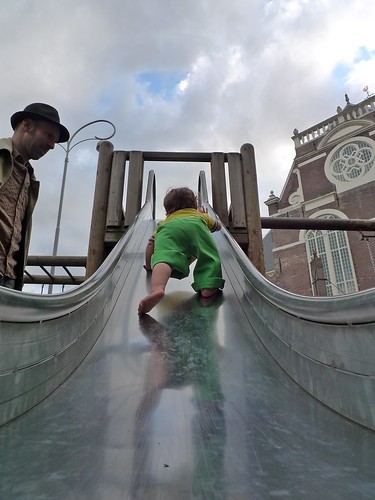
It seems that the Dutch or at least Amsterdammers give their kids a lot of freedom to play and explore. We often travel with our kids and elsewhere people are amazed or shocked to see a little one crawling around while we rest along a hiking trail, climbing big kid’s structures at a playground, or pushing a little shopping cart though the supermarket. Are they well behaved and playing safely because we’ve allowed them the freedom to learn, or are we just lucky to have a couple well behaved kids? Perhaps mostly the latter but really I cannot say. It is clear though that the local kids are given more space than kids elsewhere, and spend much less time strapped into strollers and the back seats of cars. To my untrained eye these 2-5 year olds seem more physically mature, at least with respect to the activities we see such as riding bikes and kick scooters, and climbing in playgrounds.
4. 12 months: Riding a baby bakfiets

I bought this tiny, antique, wooden bakfiets two years ago on Queen’s Day for €5.00. Since then my son and countless other kids have enjoyed it. P1 began riding it about when he began walking thus about a year old. It’s really tiny and maneuverable and that makes a big difference; Kids have to feel comfortable with these “toys”. I really believe that the ergonomics influence their experience and learning curve considerably. The lesson: Get little vehicles that fit and work properly and that are light enough for the child to have fun with. If necessary tinker a little to lower a seat so so your child get her feet on the ground, or shorten a handlebar because the manufacturer didn’t bother to do so. Most of the little bikes and trikes our kids use have been modified in some simple ways.
After a few months P1 would tear around the bikes at Workcycles Jordaan shop on the little bakfiets, skidding the rear wheel or intentionally flipping it, giggling as he rolled across the floor. Probably once or twice he hurt himself enough to cry but I honestly cannot remember it.
5. 18 months: Riding a Micro Mini scooter
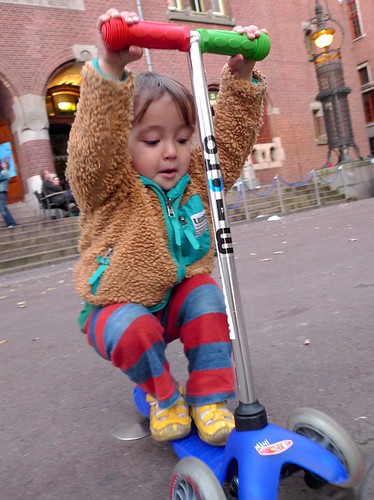
P1′s first experience in riding a wheeled vehicle requiring balance was with the Micro Mini Scooter. The box says ages three and up but that must just be to please the lawyers of the firm’s American distributor. Even much younger kids love riding these little kick scooters. At a year and a half P1 made his first tentative steps around the shop (with the handlebar at about eye level) and gradually developed his skills on it. A few months later he would speed through the store, surfing through the parked bikes. What’s great about the Micro Mini is that it’s a three wheeler with the behavior of a two wheeler. At rest it stands up so a child can easily begin pushing around on it. But it steers by leaning with very natural dynamics so to really ride it one must develop the same balance skills as cycling. It also folds up to carry in a bike basket or backpack and weighs approximately nothing.
6. 25 months: Riding a balance bike

Once P1 was comfortable on the kick scooter I figured he could also ride a balance bike. He wanted to try it but even the smallest model (the Micro G Bike) was too tall for him at 18-19 months. I made the mistake of encouraging him to try anyway but then he fell off several times, got frustrated and refused to go near it for the following half year. Even lowering it my installing smaller wheels and dressing it up as a motorcycle (like many little boys he’s fascinated with motorcycles) didn’t help:
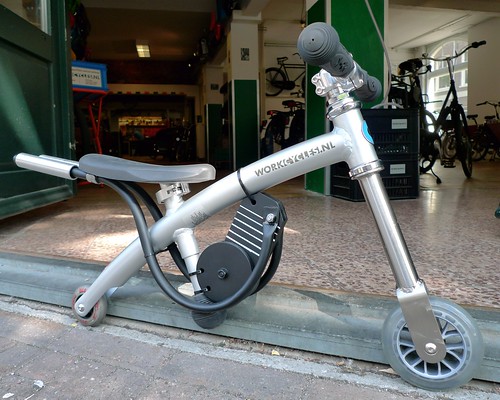
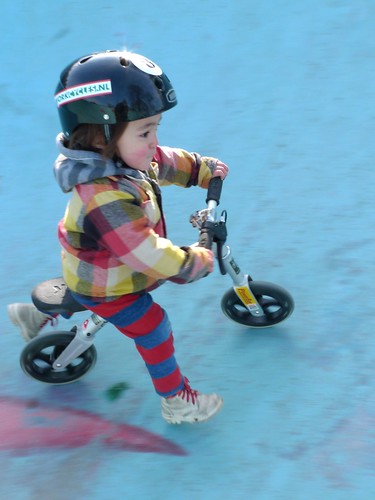
Then one day at about 25 months old he just stepped over the G-Bike and pushed off. Already having months of experience on both the little bakfiets and the kick scooter it was only a few minutes before he was gliding through the shop this time.
P1 became inseparable from his balance bike which has been really handy for mom and dad. He rides it to the store, to the park, and the whole day alongside us as we go about our business in the city. Rarely do we need to carry him. He’s much faster on the bike than Kyoko walking with P2 in the stroller or on our backs so he stops and rides up and down steps or practices other tricks while mom catches up. We’ve even dropped him into the local skate/BMX bike bowl to copy the tricks he sees the big kids doing.
7. 32 months: Riding a real bike without pedals (without training wheels)
He only did this for a few hours and I didn’t think to take a picture. To ease the transition from balance bike to bigger and heavier “real” bike I removed the pedals and let P1 ride around for an afternoon. He knew exactly what was going on and was totally psyched to ride his “real BMX bike”. Not only did this help P1 get used to the bike, it also gave me an opportunity to adjust the handlebars and saddle for him. Even at their lowest adjustments both saddle and handlebar were too high. I shortened the seat post and cut a couple centimeters off the top of the seat tube to lower the saddle. The handlebar was far too high so I fashioned an adapter to clamp it at the crossbar instead of at the normal spot. I would have just replaced the handlebar with a lower one but this stem has strange dimensions.
Note that this bike never had nor will have “training wheels”. That’s because training wheels actually hinder the process of learning to ride a bike.
A little about the bike itself:
I did quite a bit of research into the available kid’s bikes with 12″ wheels before buying. Almost of the bikes in this size are really awful; badly “designed”, crudely made and shockingly heavy with terrible bearings, covered in tasteless graphics. In fact the only decent 12″ bike I found was this Specialized Hot Rock 12. It has an aluminium frame, rims and handlebar, good quality tires and fairly tasteful graphics. By no means is it perfect. The cheap, steel cranks are much too wide forcing P1 to pedal like a duck (if a duck could pedal, that is) and the handlebar and stem are too tall and have nonstandard dimensions. It weighs 7kg without the training wheels which we never used. That seems light for us but really isn’t light for a 12kg rider. For comparison sake his Micro G-Bike weighs just 2kg.
8. 32 months: Riding a real bike
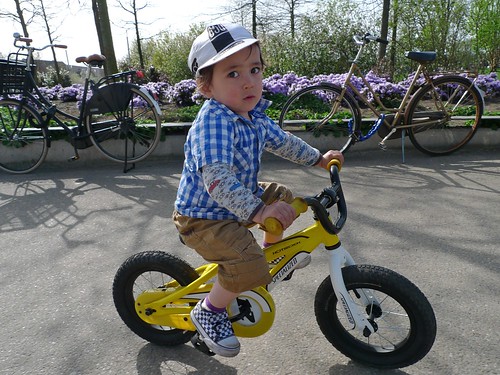
A few days later we brought the “real BMX bike” to the Vondelpark, this time with the pedals installed. P1 wasn’t so happy about this development so first we flipped the bike upside down and made a game of “pedal”… “brake”… “pedal”… “brake”. That was fun so then we did the same with him on the bike, me supporting the bike from the saddle while he pedaled and braked his way around the park. I gradually held the bike more and more lightly and after a few minutes he continued pedaling (and balancing) alone. After all P1 had long since developed the skills to ride the bike.
The following weekend P1 did a few laps around the big Westerpark and really became more relaxed on his bike. Though kids learn to ride young here it’s still rather strange to see such a small child riding a bike. Thus P1 gets an incredible number of stares, “awwww look, how cute”s, and “How did you do that? My child is four and still can’t ride a two-wheeler.”s
So now P1 can ride a bike but actually he still prefers his balance bike. Each day when we head out together I ask him which bike he wants and he always chooses the G-Bike. Why? Because it’s smaller and lighter and more fun. P1 can toss it around, try doing wheelies, carry it up steps, fall off it painlessly. That little bike is to him what a BMX or trials bike is to a big kid. And I’m very happy about that; I’ve had the proud papa moments of seeing my 2 year old ride a real bike yet we can still go about the city with his much lighter and easier to carry (in the basket of my own bike for example) balance bike.
I wish you the same success making your own little ones into happy cyclists!
Email This Post


April 28th, 2011 at 11:15
awwww look, how cute’!
i like the steer lowering solution
April 28th, 2011 at 15:52
Great piece. P1′s a lucky kid to have access to all those devices!
In my bourgeois side of Paris, I see a lot of kids on wooden (sometimes metal) draisines, like the Micro G up there but clunkier and with bigger wheels. I suppose they’re a good tool to learn balance, do you sell/recommend any?
Also, this confirms my feeling that my childhood bicycles were pretty crappy. I remember thinking that my sister’s Miss Peugeot was a fine piece of equipment ; I don’t know if they make good kids’ bikes anymore, even for older kids…
April 28th, 2011 at 15:53
Also, I gotta track down that Youtube video of a 5-year-old learning to ride a fixed-gear bicycle… it was pretty rad.
April 28th, 2011 at 20:59
nicolas,
The original (as far as I know) balance bike/laufrad/loopfiets was the wooden Kokua LikeBike from Germany. These are really nice though heavier and not as indestructible as the Micro G-Bike. Since then a legion of copies have appeared, some of which are decent and most of which are crap. The crappy ones are heavy, have bad ergonomics, get lots of flat tires and break down quickly. My attitude: C’mon folks, these bikes really aren’t so expensive and your kid(s) will get immense joy and learning from them. And if the budget is really limited good second hand products are generally better than cheap new ones.
The Specialized Hot Rock I got for Pascal is pretty good but it was the only halfway decent 12″ bike I could find. The rest were awful. The smallest quality bikes I’ve seen are the micro mini BMX racing bikes offered by a number of the BMX bike companies. These are very light 18″ wheeled bikes intended for kids about 5-6 years old. Being real competition bikes they’re pretty pricey; at least €400 or so.
Riding a fixed gear shouldn’t be much harder than a bike with a freewheel. In fact all of the antique kids bikes we’ve restored were fixed gears and they were 16″ wheelers, thus for 4-6 year olds.
April 29th, 2011 at 00:46
hi Henry, my son Harry has the same scooter and the same Vans shoes as Pascal
Harry’s great on his scooter but doesn’t have a balance bike yet, so now I have the perfect idea for his 3rd birthday present next month, cheers!
Dan
April 29th, 2011 at 06:38
Dan,
The modern version of “Great minds think alike.” must be “Great minds buy alike.”
April 30th, 2011 at 02:21
Great post Henry, that’s fascinating to see the progression.
I think you’ve hit the nail on the head regarding freedom (point 3 above), kids need freedom to play, experiment, and occasionally fall on their heads, all of which they learn from. Although my son (nearly 2 1/2) hasn’t mastered bicycles like P1 (I work in a school not a bike shop!), he does demonstrate both good physical competence and more importantly a sensible attitude to risk, and (although this is also a sample of one) I do think these have been developed at least partly because in the park and elsewhere I pretty much let him do anything he wants to do – sometimes I’ll insist Dada stands right behind ready to grab if he slips, but I’ll never stop him climbing something he wants to climb.
Anyway, now I really want to buy him a micro-g, so I’m off to amazon. Thanks for the inspiring post!
April 30th, 2011 at 06:29
ten,
The “sensible attitude toward risk” part is something I didn’t write much about but it’s definitely a key factor. Again it’s all educated speculation but it seems that kids who’ve grown up with the space to constantly test their limitations learn to be more intelligent in their assessment of risk. To some observers these kids appear to be rather wild while, in fact, the opposite is true; The risks are (generally) well calculated. P1 is definitely not a wild kid.
Case in point: A couple days ago we were at a big, wooden climbing structure in woods of the Vondelpark. It’s intended for bigger kids and is comprised of a series of vertical and 7m or so high horizontal “challenges”, all protected by a steel wire net so one can’t actually fall very far. We’ve done it together two dozen times and P1 had just learned how to get past the most difficult challenge, a pair of steps about shoulder height for him. P1 was alternating between riding his G-Bike and climbing (with me) through the structure, wearing his backpack and helmet (at his insistence; perhaps he feels like a climber or mountain biker or so) . I was talking with friends when we realized we hadn’t seen him for a couple minutes. He wasn’t at ground level and we couldn’t spot him inside the tunnel-like structure. A minute later P1 appeared at the other end of the structure with a big smile, proud that he’d done the whole thing himself. Yes, a little scary but really he didn’t run off willy nilly.
May 4th, 2011 at 14:20
I enjoy this blog a lot.
I am currently trying to fasten a child’s car seat in my Christiania cargo trike. There is absolutely no tradition for this where I live, so I’m greatful for the inspiration here.
May 4th, 2011 at 17:37
Eh, my two kids really learned balance on a scooter too.
They did pedal with training wheels until the age of 4 though.
I totally agree with you about the benefit of early freedom of movement. I’m a firm believer that kids who acquire those balancing, proprioceptive (is that a correct word ?) skills, at a very early age will grow as more athletic, skilful and generaly healthier adults. It becomes ingrained more deeply in them.
(Oh, is that a workcycle road bike on the family pic ?!)
May 10th, 2011 at 12:34
Unfortunately teachers.tv isn’t available anymore but there was a film with Tim Gill and others showing that children who were exposed to (small) risks as children were better at assessing and managing risk/danger later in life.
http://www.csec.org.uk/school/TeachersTV.asp
http://news.bbc.co.uk/2/hi/uk_news/education/8107858.stm
http://www.rethinkingchildhood.com/no_fear.html
May 10th, 2011 at 13:06
what do you all think of requiring a bicycle proficiency test as a prerequisite for any motor vehicle license?
some high schools in the U.S. have a car driver education course.
some people never get started on two wheels.
some U.S. cities have proposed a bicycle operator license requirement.
my motorcycle license required passing a car driving test, (written and performance), before doing the same for the motorcycle.
it was odd to read this about the motorized, four wheeled Canta:
No driver’s license required!
You can legally drive them in bike paths and (the company says) through shopping centers
They all feature a Honda engine of either 160 cc or 200 cc
http://www.amsterdamlogue.com/the-worlds-smallest-ca r.html
May 10th, 2011 at 22:31
Philippe,
Well, it’s sort of a Workcycles road bike. Building custom racing bikes isn’t one of Workcycles activities but it is part of my background. So sometimes when I build a bike for a friend or family member Workcycles logos show up on it.
May 10th, 2011 at 22:33
Son of Shaft,
That would certainly support my and various commenters’ gut feelings about children’s relationship to risk, and it seems sensible.
May 10th, 2011 at 22:39
zyzak,
“what do you all think of requiring a bicycle proficiency test as a prerequisite for any motor vehicle license?”
I’m not so sure about adding regulations to something so simple as cycling. Wouldn’t it be more straightforward to just ensure that understanding of cyclists is part of the testing to become a motor vehicle driver?
Cantas are basically regarded (legally) as being as innocuous as covered wheelchairs and I have to say that (aside from sometimes finding them parked in annoying places) I’ve never found them to be a problem. This in great contrast to the many a-holes who ride the “snor-scooters” on the bike paths here. I wrote about that in a recent post:
http://www.bakfiets-en-meer.nl/2011/03/21/scooters-and-a-daycare-center-terrorizing-the-bike-paths/
May 20th, 2011 at 05:10
I love your attitude about helping children develop a healthy relationship to risk, and the photos of P1 tooling around on a “big kid bike”. As a parent who spent some time last year looking for a good 12″ bike for my oldest son to learn on, I take some comfort in the fact that it’s hard to find one, even in the Netherlands! Do you think it’s possible to make a relatively affordable, lightweight, and sturdy 12″ bike?
May 20th, 2011 at 05:49
Emily,
Thanks! After discovering the amazing dearth of good bikes for small children I briefly investigated doing a line of Workcycles for kids. In order to do the job really well it’d be necessary to first design and produce not only the frames but also several parts that don’t seem to be available: decent cranks, a little handlebar and preferably a lower volume and lighter tire.
I quickly realized that the economics probably can’t add up. Only a small number of parents seem to be willing to spend “real money” on a bike they perceive as being so temporary and unimportant. I disagree strongly but that’s doesn’t help unless I can convince several tens of thousands of parents otherwise.
Also there’s so much crap on the market for such low prices that any bike sold for a considerably higher price will be relegated to a small niche market, killing the possibility of making them in quantities great enough to get a decent economy of scale, thus driving the prices even higher.
May 21st, 2011 at 03:44
Zyzak: I don’t think anyone should be forced to learn how to ride a bike, even as part of the deal of getting a motor vehicle operator license, unless it is proven that it makes the driver safer in regards to cycling.
You are in Poland? How much about e.g. “bike awareness” is there in driver’s education there?
May 22nd, 2011 at 07:27
I can add to the statistics. Same learning curve here, albeit only balance bike and then straight to “real” bike. The pedal movement had been learned on a “skelter” and those play car things.
Put him on his bike for the first time at about the same age as P1, he pushed off and was away without training wheels. To our utter shock, BTW.
I am utterly convinced it’s the balance bike that’s the key. Braking by back-pedaling came in a few days practice. His bike also has a single brake-lever for the front wheel, too, which is confusing.
We are now in the tough decision regarding helmets, which seem to be becoming more prevalent for kids. I am undecided for now.
May 23rd, 2011 at 19:56
no force to learn to ride a bike.
many drivers in the US are oblivious to the cyclist under their SUV.
even the police do not know the rights of cyclists in their jurisdiction.
May 23rd, 2011 at 20:17
Zyzak, you may be interested in this: http://www.bikerumor.com/2011/01/01/new-york-likely-adding-bicycle-awareness-to-drivers-ed-curriculum/
May 26th, 2011 at 15:58
thanks Todd
it goes to show;
teach a poor slob to ride a bike, and he eats rocks for a day.
teach a millionaire to ride a bicycle and you can ride all over Manhattan for his term as Mayor.
May 26th, 2011 at 19:59
Zyzak, I am not sure what you are talking about. Manhattan-bias in NYC bike infra? Other downsides to PlanNYC? In any case, I am sure the installed stuff will last — the question is if the next administration will continue the plan…
May 27th, 2011 at 15:08
Hello,
I’ve been looking your website and very excited about putting my child who is 6 months on a bike.
I’m looking at either a bakfiets or a FR8 (probably more the backfiets).
My main issue is that I live in Paris where circulation is very tight. I talked to Vélos Parisiens who apparently just received FR8s from you (which I hope to try out this week end).
However, after talking to them, they where indicating that if I took a backfiets it should be the short one. What are your thoughts on that? Yours seems to be a long one. I was looking to a long one too, but am now hesitating.
Many thanks
Max
May 27th, 2011 at 15:35
I will go out on a limb and tell you what Henry’s answer will most likely be: get the Cargobike Long.
I will leave it to Henry to explain why. But in my opinion the longer bike costs marginally more, has much more room, and is not “more difficult” to ride. The Cargobikes are actually incredibly normal to ride but the perception by the uninitiated is that they may be hard to ride and the short one would be easier.
We have a long version. Added benefit is that when kid 1 is older, he/she can sit on the bench and the baby will still fit in the bak.
May 27th, 2011 at 15:46
Thanks Feddo.
This is not a problem of price on my side. It’s more a question as to when
May 27th, 2011 at 15:48
Sorry, this went out too fast.
So, it’s not a price issue on my side. It’s more ridding through traffic in a city not truly organised for bikes…
I was really going for the long one originally.
From my stay in amsterdam and copenhaguen, I understand why this would work there.
Many thanks for your advice
May 27th, 2011 at 16:13
Maxime,
Feddo’s pretty close to the mark on that one. We do actually also sell the short version Cargobike but for the reasons that Feddo wrote we sell many, many more long ones than short ones.
The short Cargobike a really sweet riding bicycle; It rides just like a good city bike. But the long version rides only slightly differently and offers far more possibilities. The most common deal breaker for the short model is the option or need to carry a newborn baby along with toddlers on the bench. It works with the long but not the short.
They’re both great bikes but at least in flatter regions we sell about 30 times as many long ones as short ones.
May 27th, 2011 at 20:54
I found this other example http://www.cyclorama.net/blog/cyclorama/cyclorama-welcomes-toddlebike/ (I like the name – you can imagine the playful taunting I once suffered – and that the kid pictured is not happy).
May 28th, 2011 at 06:35
Were you a “toddler” for a particularly long time, Todd?
That simple little four-wheeled bike should also work along the lines of some of the little vehicles I described above but it’s really just for kids around the age they learn to walk, like P1′s little bakfiets. Beyond that it should generally be better to be riding things that require balance… without being overly obsessive about it of course.
What just makes me sad is seeing kids (often older than P1) being pushed around in those horrible plastic tricycles with a sort of rollcage around the child. They seem to have been designed only to avoid the wrath of liability lawsuits. You can just sense the kid’s despair seeing their peers gliding around on balance bikes.
May 28th, 2011 at 07:44
@Henry, truth be told, I am always my own inner child.
Not sure why but I learned to ride so late in life – perhaps it was when I was age 5 in 1971 – I remember my first training wheels-removed ride down the sidewalk to Billy Stuck’s house at the other end of our west San Fernando Valley http://en.wikipedia.org/wiki/San_Fernando_Valley#Transportation block. Not sure if the training wheels by themselves delayed things so much, and I know had tricycles earlier etc. Maybe the other kids did this a little earlier. A good friend’s kids in semi-rural Sebastopol, in northern California were using folding scooters up until last week and got bikes and learned to ride in one week at age 5 and 8. But in 40 years no progress? Again, not sure if our cases are typical but check this out:
“Training Wheels – Training wheels help the child develop a sense of balance
Start with the training wheels solidly on the ground; they will hold the bike upright
Gradually raise the training wheels; remove them when they start to get in the way”
&
“When – Once a child can hold their head up and fit a helmet, they can be a passenger
Until about age five, kids should ride in a child seat, or better yet, a trailer
Kids need basic motor skills to operate a bike.”
The source: http://www.bikeleague.org/resources/teach/parents.php (The same page has a 40-pg downloadable “tip sheet” on cycling… sigh… which among other things seems to be written in a cargo-bike less universe. It seems to provided as a resource for bike shops, too, but maybe there is a lot of crap on the Bike League site that they want to purge.)
There is so search function on their site, but – to be fair, I guess – Googling “league of american bicyclists” + “balance bike” results in only two hits on their website: The first is http://www.bikeleague.org/members/specialoffers.php which has a link to a retailer who offers and properly describes balance bikes, and the second suggests removing the pedals from an existing small bike as a DIY balance bike (which implies a much larger conveyance than P1 starting balancing on) – http://tinyurl.com/44w9w9s.
As we know, in the years between 1971 and 2011 young-child riding (in particular trips to e.g. school) declined with the lowest point probably in the middle of that period – I walked to school, by the way – which results in the bad urban riding skills in e.g. a lot of the “American” expats here in Berlin who are around age 20 to 30.
May 30th, 2011 at 18:59
And I know this will sound truly lazy… but do you think it’s worth considering an electric Bakfiets.
I mean Paris is not exactly what you call flat. It looks very flat to the pedestrian, but after having ridden about ten years accross the city there are serious hills (although nothing compared to Porto or Athens).
Any thoughts?
May 30th, 2011 at 22:27
Maxime, We’re somewhat off topic here talking about electric bakfietsen below a post about teaching kids to ride bikes. But this has been discussed at least in one other post:
http://www.bakfiets-en-meer.nl/workcycles-faqs-overviews/bakfiets-cargobike-tips-tricks-faq/
There is probably more on other posts. Try searching here for “electric” and “bakfiets” or “cargobike”.
Anyhow, to answer your question: Yes it’s worth considering. But do understand that adding the “e” to the bakfiets also adds much complication, far more maintenance and repairs, obsolescence within a few years, expensive battery replacement every couple years and a much higher price tag.
I know Paris has hills, but do you really need to ride with the kids over them regularly? Even with a motor on it those steep streets in Montmarte will be impossible. After riding Paris for a few days last year I decided I’d rather ride a more compact, regular type bike than a bakfiets. that’s probably why we sell quite a few Fr8′s there, mostly equipped with two child seats.
May 31st, 2011 at 08:38
Dear Henry,
Thanks very much and aoplogies for the off topic. As soon as I put my son on a bike I’ll post something here !!! (unfortunately some time to go)
May 31st, 2011 at 12:25
Well I just bought a pedal bike for my son Harry’s 3rd birthday in a couple of weeks.
The bike shop are taking off the whole drive system to convert it to a balance bike, and they’ve very kindly said they’ll put it back on again for no charge.
Also they’re going to flip the seat clamp to lower it by another half an inch or so – top tip!
I’m excited for him
Dan
June 5th, 2011 at 07:41
Dan, That’s really very kind of your bike shop considering that the labor costs to disassemble and reassemble that bike will approach or exceed their profit margin on the little bike. Somebody there is clearly enthusiastic about getting kids on bikes and I hope it builds them a loyal clientele.
June 8th, 2011 at 04:34
This seems useful http://news.yahoo.com/video/neworleanswdsu-23824923/program-helps-disabled-kids-ride-bikes-25423433#video=25500496 (I told them the helmets were poorly adjusted).
June 10th, 2011 at 18:58
LOVE This so much- my two boys have been riding since they were very young. My eight year old son Ethan just got on his firs roadbike this year- his brother’s hand me down.
See our adventures at this year’s Bike Ride Across Georgia (BRAG) event this year:
“I kept the kids out of school today and we headed down to Madison, GA from Atlanta after breakfast with a van full of bikes, equipment and camping gear.”
http://teameddie.wordpress.com/2011/04/19/team-eddie-2011-brag-spring-tune-up/
June 14th, 2011 at 03:57
Here’s an interesting bike I saw while looking for a bike for my daughter. Haven’t tried it, but like the idea…
http://www.hobby-bike.com/concept.php
June 15th, 2011 at 01:40
this week my son got a present from his grandparents – a micro-g balance bike! I’d sent them the link after seeing Henry’s recommendation and they ordered it from amazon. My son is thrilled, its got two wheels like the big kids’ bikes! He’s not very quick on it just yet (less than half a mile per hour by my calculations – makes for a bit of a slow dog-walk) but he’s getting used to it and he REALLY loves it. Thanks for the tip, you’ve made a 2 1/2 year old really happy (and his dad too…)!
June 15th, 2011 at 06:26
Jonathan, I’ve seen a couple kids’ bikes that convert between run bike and pedal bike. Seems handy if well executed, which kids’ bike generally aren’t. The other one I saw seemed somewhat slicker but I don’t remember who made it.
On the other hand the convertible bike misses some of the advantages that a well-designed run/balance bike can have. In particular the Micro and a couple others are very compact and lightweight (2kg). That’s both better for the child and handier for the parents who’re constantly carrying the thing. The convertible bike looks like a heavyish kids bike minus cranks and chain. Even P1′s aluminium Specialized weighs 7kg and is much bigger than the Micro.
June 15th, 2011 at 06:39
ten, Great to hear! I wish him lots of fun and learning on his little bike.
A couple months later and P1 still vastly prefers his G-Bike to the “real bike”. The yellow bike only comes out at his request to show off at picnics and parties.
June 19th, 2011 at 15:02
My 3 year old daughter also has a push-bike and a pedal bike ( which she hasn’t actually pedaled yet– it fits much worse than Henry’s does ). Still sometimes she requests to play with the pedal bike. Like P1, she still clearly much more enjoy’s the push bike.
Recently I took her out on a bike path with the push bike, and I learned that there is much more than that can be mastered on a push bike: She was learning how to handle the bike going down hills, and lots about riding in the “traffic” of the bike path: staying to one side to let others pass, being mindful of blind hills and corners and not stopping suddenly un-announced so dad doesn’t crash into you. And frankly, these are all fine things to be learning without the extra speed that a pedal-bike could add.
June 24th, 2011 at 22:44
Another perspective:
When Juli plays outside, she is just like all the other kids. She steers her training bicycle fearlessly past posts, dogs and bicycles parked at an angle, chattering away the whole time. Her parents make a big effort not to appear anxious. Juli is supposed to learn how to find her way by herself. She is allowed to play around on chairs and to climb rope ladders on playgrounds. “One bump on the head won’t kill you,” her father says. He and his wife only allow themselves to warn her when she is in real danger. Doing so is the only way to make sure that Juli learns to deal with the frightening things that can happen in the real world. – from http://www.spiegel.de/international/germany/0,1518,768868,00.html#ref=nlint
June 24th, 2011 at 23:49
Wow this comment thread is getting pretty broad! That Juan Ruiz is a revelation though, cheers for posting the link
June 25th, 2011 at 06:06
Wow, I wasn’t expecting that Todd! Thanks.
July 19th, 2011 at 14:38
The “sensible attitude toward risk” part is something I didn’t write much about but it’s definitely a key factor. Again it’s all educated speculation but it seems that kids who’ve grown up with the space to constantly test their limitations learn to be more intelligent in their assessment of risk.”
I struggled with just this notion of risk the other day as I contemplated my 11 year old’s first ride in the mountains of North Georgia here in the US. Read what I came up with, and the write up on the resulting ride on my blog:
http://teameddie.wordpress.com/2011/07/15/cycling-parent-fear-and-self-doubt/
http://teameddie.wordpress.com/2011/07/18/liam-earns-polka-dot-jersey-north-georgia-mountains/
July 21st, 2011 at 04:26
Can a playground be too safe? http://www.nytimes.com/2011/07/19/science/19tierney.html
August 13th, 2011 at 02:41
The looks cool effect is useful but do these add functionality? http://networkedblogs.com/lCQE7
August 14th, 2011 at 07:55
Todd,
I suppose the main advantage of those designs is for the manufacturer who can cheaply make them from molded plastic. I’ll take Micro’s simple aluminium tubes or Kokua’s lovely wooden designs, thank you.
September 2nd, 2011 at 13:59
What will Pascal be doing by age four? http://www.youtube.com/watch?v=Yi6GUf3IiAA
September 3rd, 2011 at 08:30
Todd,
That video has been removed. What was it about?
BTW: Just back from Eurobike where we searched the halls for good looking little kids’ bikes but didn’t find much at all. It’s mostly just the same generic, awkwardly designed, heavy crap. One firm called S-Cool has some OK looking little bikes though they were really only just barely better enough to stand out a little from the crowd. Puky now makes their decent but ugly little bikes in aluminium to be a little lighter.. though it was still 7 or 8kg for a 12″ bike. Easy Rider showed a neat prototype of a light 16″ bike with belt drive but my experience says that the design will get watered down and compromised considerable if it goes into production.
September 3rd, 2011 at 12:09
Hi, here is the same video, uploaded by someone else… http://www.youtube.com/watch?v=nyrw2dy6qgA
October 23rd, 2011 at 00:17
Are kids missing out on the power slide? This just got funded… barely… by 70 bucks over the goal… http://www.kickstarter.com/projects/bigwheelrally/the-high-roller-adult-size-big-wheel-trike
November 14th, 2011 at 23:37
Hello from Paris and from a near to be owner of a cargo bike and near to be father !
It’s been a few years that my partner and I are convinced of draisienne’s qualities for balance education.
I recently saw this video about an amazingly skilled young boy, I bet his parents are pretty proud of him :
http://vimeo.com/20572951
Thanks Henry for your very thoughtful blog, I arrived on it by Josh’s article about carbo bikes (I read all the comments and I’m still convinced to go for a Bullitt) and now I’m reading past articles with great interest.
March 22nd, 2012 at 16:19
Just read the thread. My nine-year-old son is already a skilled cyclist and we are on to the next frightening stage; letting him go by himself on his daily route to and from school, by way of a roundabout and a crossing with traffic-lights. He can do it, but can we…
.
When he was little the push-bikes were not that common and I still regret that he didn’t get a chance to try one. Now we had to deal with training-wheels and a frightened boy that could ride a bike, but not stop it yet. Later on he used our hedge to tackle that problem
April 26th, 2013 at 21:08
I purchased a used g-bike for my 20 months old son, not expecting him to immediately use it as he is happy with the micro step. To my surprise he instantly grabbed the bike and climbed on it. Unfortunately he is just a bit too small for the bike so he needs some help to get around. He refuses any help so I want to lower it by putting smaller wheels on it. Henry, what wheel did you use and why not two? Whould two rear-wheels of the micro-step do the job?
April 26th, 2013 at 22:01
Hi Edwin,
How cool that you’re little boy already wants to ride the run bike. I put a standard inline skate wheel in the back. I don’t remember the exact diameter but it was probably a 76mm or 80mm wheel, thus lowering the seat at least a centimeter.
I didn’t do the front wheel for two reasons: Firstly the size of the rear wheel has much more influence on the saddle height and secondly a smaller front wheel gets stuck in cracks and little holes.
May 17th, 2013 at 16:38
Dear Henry,
We just wanted to say a big ThankYou for the advice you gave us about lightweight cycles for kids. It has been about a month since we entered your shop on Lijnbaansgracht hoping to fix our son’s Micro scooter and also try all available kids’ cycles hoping to buy Lenny a bike for his 4th birthday. Our everyday nursery run was 1 mile each way (first done with a pram, then on a scooter, then on a balancing bike and finally on a 12″ bicycle). You advised us to try an Islabike.
Unaccustomed to the price range we attempted to save a bit and bought a second hand 14″ Islabike that unfortunately had a clunky bottom bracket. But it was really light and Lenny loved it from the first sight. Since I could not fix the BB myself, I sent it back to where it came from, took a deep breath, and we ordered a brand new 16″ Islabike directly from the factory.
Lenny simply loves it! The new bike has acquired many names, including “the Fast bike”, “the school bike” etc. A few days ago he rode a total of 12km during one day which also included other physical activities. The future looks bright
Best regards,
Leo and Daria (happy parents)
PS: we are still considering FollowMe tandem attachment that you suggested, too.